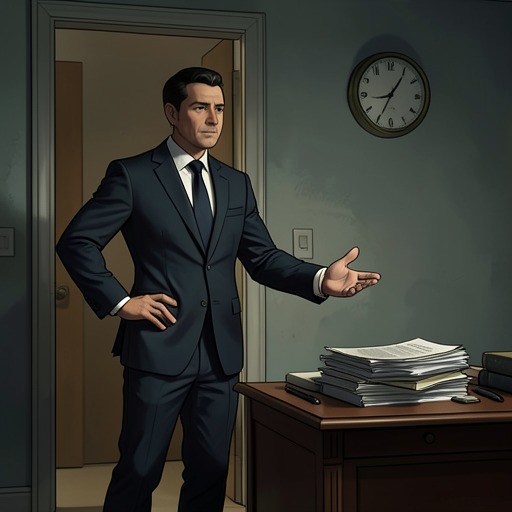
Bruiser Stone
The RainmakerBruiser Stone is a powerful, ethically compromised Memphis lawyer whose protection and patronage draw Rudy Baylor into his orbit just as federal authorities are closing in on him and Prince Thomas. His story turns on a contradiction: he can use his influence to help a vulnerable young lawyer and advance the Black family’s case, while building his own practice on coercive economics, corrupt relationships, and criminal ventures. When he vanishes, those contradictions become liabilities for everyone left in his office.
Identity and Background
Bruiser is described as enormously broad and weighing at least 350 pounds, with long, thick gray hair and a sagging goatee. His friendship with Prince Thomas began in a tough South Memphis neighborhood, where the two drank, gambled, chased girls, and fought. Their adult partnership preserves that old intimacy but gives it a criminal and political dimension: Prince is the public-facing operator, while Bruiser does the thinking and supplies the legal expertise.
The pair count cash in private and bribe politicians and police. When Prince is caught, Bruiser appears publicly to complain of injustice. Bruiser is effective in court, but the account attributes part of that effectiveness to his willingness to offer jurors substantial sums. Prince, confident in the protection this arrangement provides, is described as unafraid of guilty verdicts. Their friendship is therefore also a division of labor: Prince fronts their dealings, and Bruiser manages strategy and legal exposure.
Practice, Power, and Methods
Bruiser runs a small firm with several lawyers and owns the red-brick strip-shopping-center unit where its offices are located. The office is in an industrial section near the airport, between a cleaner’s and a video-rental shop; across the street are an all-night pancake house and Club Amber. Inside, the rooms are windowless and gaudily decorated, with photographs of important-looking people alongside Bruiser. His practice is nevertheless active: the offices contain lawyers, secretaries, a library, files, and the ordinary equipment of legal work. He says the property was paid for and bought fifteen years earlier.
His employment terms place much of the financial risk on associates. When Rudy needs work after losing his position at Jonathan Lake’s firm, Bruiser offers him a monthly draw of $1,000, but requires him to generate enough fees to cover it. One third of fees goes to the office fund, one third to Bruiser, and one third is credited against the associate’s draw; if the associate fails to earn enough, the shortfall becomes a running debt. Bruiser says the system is the only one that works for him. His own practice has included partners and dozens of associates, and he says their earnings vary substantially. Rudy accepts despite recognizing that the arrangement could leave him owing money, because he is in urgent need of employment and legal protection.
Bruiser also shows a practical capacity for generosity. After a quick settlement for Dan Van Landel, he gives Rudy and Deck a third of his own share to divide between them. The gift amounts to $5,500 each, which Rudy understands as a reward for passing the bar exam. Bruiser has personally spent less than six hours on the settlement, and the episode leaves Rudy and Deck astonished at both the size of the payment and Bruiser’s willingness to share it. The generosity does not erase the imbalance of his fee system; instead, it shows how unpredictably he can reward associates while retaining control of the practice.
Rudy Baylor and the Black Family Case
Bruiser’s association with Rudy begins as an act of assistance. After the Lake firm burns and the police show interest in the fire, Rudy turns to Prince because he cannot afford a lawyer. Prince calls Bruiser, who agrees to meet with them and says he will handle the danger of Rudy’s possible arrest. Bruiser advises Rudy to keep a low profile, explains that investigators may need days to determine whether the fire was arson, and says he has contacted people he knows in the police. He promises to be present when Rudy gives a statement. Although Rudy knows Bruiser’s reputation, he finds himself trusting him in this moment of vulnerability.
Bruiser then employs Rudy, whose legal status is still unsettled, and gives him an office key. Rudy soon presents him with the Black family’s case against Great Benefit and explains that Barry X. Lancaster has taken control of the matter after Rudy’s dismissal from the Lake firm. Bruiser is interested in filing before Lancaster can act. He reviews Rudy’s draft complaint and a letter terminating Lancaster’s representation, recognizes the strategy, and approves the plan on condition that the clients agree. He also introduces Rudy to Deck Shifflet, an associate with experience reviewing insurance policies.
Bruiser lends his name and signature to the complaint, filed under the name J. Lyman Stone. The four-page suit names Great Benefit Life Insurance Company and its missing agent, Bobby Ott, and seeks $200,000 in actual damages and $10 million in punitive damages. Rudy files it shortly before the clerk’s office closes, then takes the filed complaint to the Black family and obtains their signatures ending Lancaster’s representation and retaining Bruiser’s firm. Bruiser’s sponsorship gives Rudy’s work formal standing and allows the case to move forward, even as the clients’ practical dependence on their lawyers remains clear.
Flight and Federal Indictment
The partnership that sustains Bruiser’s practice also makes the office vulnerable. Deck warns Rudy that federal investigators could seize files and computers in a racketeering case, putting the whole firm out of business. Bruiser’s unexplained generosity after the Van Landel settlement adds to Deck’s concern that something is about to happen. When Bruiser fails to appear, employees gather in confusion, compare their last contacts with him, and retreat to their offices. Rudy and Deck leave through a rear door at lunchtime; neither returns to work there.
Bruiser’s disappearance is confirmed in a late-night call from Deck: federal agents have raided the offices, the premises are locked by court order, and Bruiser has left town. Prince has vanished with him. By the next day, the indictment has been announced as containing more than a hundred counts against Bruiser, Prince, Willie McSwane, and others. Federal agents have also seized the topless club Vixens and Yogi’s, which authorities identify as Prince’s headquarters. Warrants are out, but neither Bruiser nor Prince is found. The investigation exposes the scale of their shared business while leaving the immediate consequences to the employees whose workplace and files are now under federal control.
Secrecy, Loyalty, and Aftermath
The later account complicates the apparent finality of Bruiser’s flight. Deck tells Rudy that he went to Dallas and then Las Vegas after a deposition, checked into the Pacific Hotel, and spoke with Bruiser by phone. Bruiser had warned him that federal agents were following him and told him to leave before returning to Memphis. Deck believes the Las Vegas detour was meant to misdirect investigators, since it was an obvious place to expect Bruiser to go. Deck does not know where Bruiser is.
According to Deck, Bruiser and Prince have left cash behind, hidden somewhere in town, and want the two former associates to help retrieve it. The sum and location are not disclosed. Deck infers that Bruiser and Prince remain together and trust him and Rudy to transport the money, but the plan has not yet been specified. The hidden cash extends Bruiser’s influence beyond the seized office: even absent, he can still draw associates toward a secret connected to his former criminal enterprise.
Rudy’s response preserves the personal bond without settling the moral question. He hopes Prince has escaped with his money and does not want him caught, despite what Prince may have done; Bruiser’s disappearance is bound to that friendship and to the danger surrounding their shared dealings. Across the account, Bruiser is neither simply a benefactor nor merely a corrupt lawyer. He helps Rudy survive a crisis and gives the Black case a route into court, but the firm, its methods, and its sudden collapse reveal the cost of depending on a man whose protection is inseparable from his own unlawful power.